

After-school clubs & camps
After the bell, they build what nobody assigned.
F7 is a ready-to-run program you can host after school — and a partnership model for organizations running paid clubs and camps. Same process, same platform, same outcomes we measured in the St. Louis pilot. You hold the room; we hand you the plan.
- Grades
- 8–12
- Length
- 6–12 weeks
- Session
- 60–90 min
- Club size
- 8–25 students
Every student finishes with a published project, a pitch, and a certificate of completion.

Host it yourself, or run it with us.
Educators lead. F7 makes it runnable. Pick the track that matches how your program is funded and staffed — the student experience is the same either way.
Host it yourself, after school
You bring the students and the room. F7 brings the curriculum, the student platform, the project structure, and facilitator guidance. Meet once or twice a week for six to twelve weeks and every student leaves with a real, published project of their own.
- Educator-led — you facilitate, F7 supplies the plan
- Fits a standard after-school block, 60–90 minutes
- Works as a club, elective enrichment, or Saturday program
- Students publish real work, not worksheets
Partner with F7 on paid clubs & camps
Schools, nonprofits, libraries, and workforce programs partner with F7 to offer paid clubs, break camps, and summer intensives. We share the delivery — program design, facilitation support, and reporting — so your team can launch a strong program without building one from scratch.
- Paid clubs, school-break camps, and summer intensives
- F7-supported facilitation and educator onboarding
- Cohort management, communications, and reporting included
- Family-facing enrollment and completion certificates
Six steps from idea to showcase.
Every club follows the same five-step design process used at NASA, Google, Meta, and Nike — scaled for a weekly after-school session and paced so students finish something they are proud to show.
- Step 01
Discover
Students pick a problem in their own community and talk to the people living it. Interviews, not assumptions.
- Step 02
Understand
They turn what they heard into a sharp problem statement — the single hardest and most valuable skill in the room.
- Step 03
Brainstorm
Rapid idea generation with AI as a research and thinking partner. Quantity first, judgment second.
- Step 04
Build
They build. Websites, apps, tools — real working products, published to a real URL.
- Step 05
Test
Feedback from peers, mentors, and real users, then another pass. Iteration is where the learning lands.
- Step 06
Showcase
The club ends with a pitch. Students present what they built to family, staff, and community partners.
The educator who proved it works.
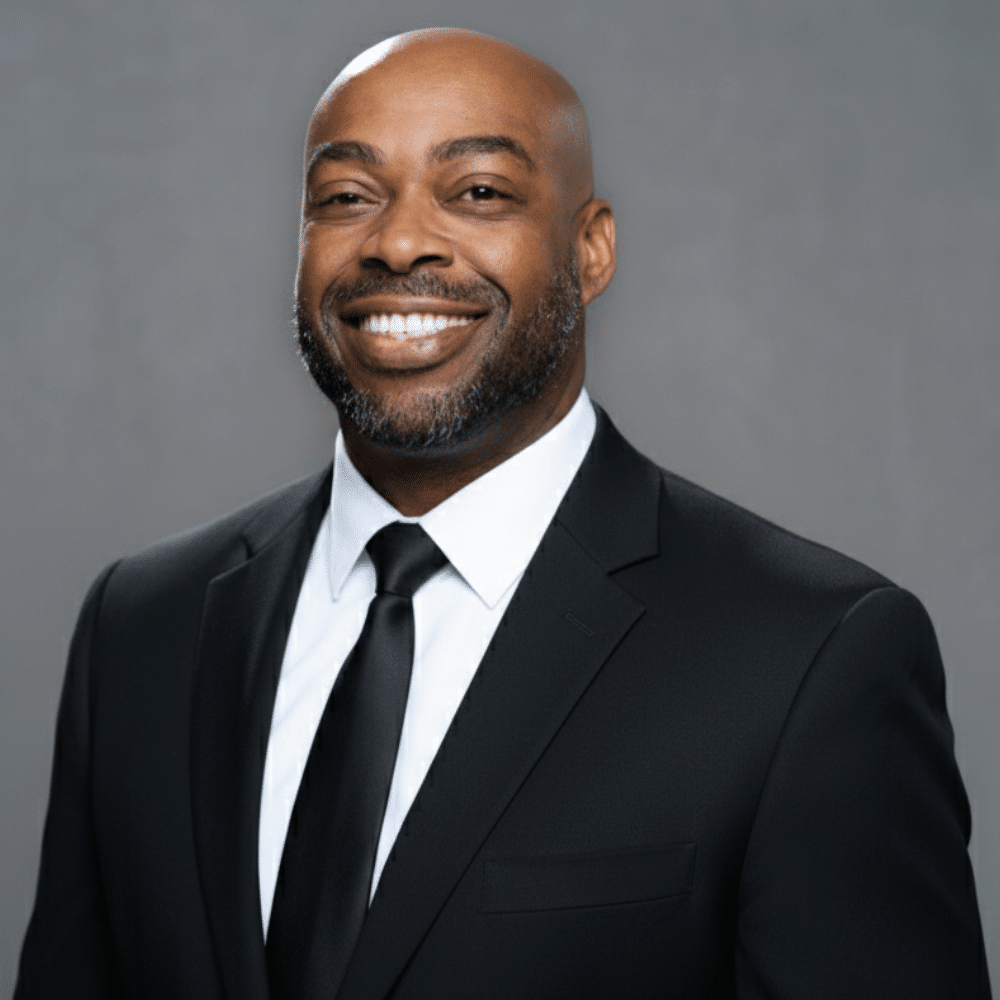
“I feel so much better about the future because of you.”
Omar Perkins led the first F7 cohort as Educator in Residence — coaching students week after week as they moved from a vague idea to a published product. He didn't lecture. He asked questions, sat beside students in their work, and held the standard high enough that they surprised themselves.
What the pilot proved is that educators can contribute far beyond traditional classroom instruction. Omar coached, mentored, and guided students through their own builds, and in doing so he showed what an F7 club looks like in practice: one adult who believes in the room, and a structure strong enough to carry students to a finished project.
That's the role we're inviting educators into. If you can hold a room and stay curious with young people, you can run F7.
Everything except the prep work.
The full F7 curriculum
Session-by-session plans across the five-step design process, with facilitator notes, prompts, and checkpoints. No prep from scratch.
The student platform
Every student gets an account to run their mission — challenge briefs, sprints, reflections, AI coaching, and their project page in one place.
Facilitator coaching
Educator onboarding plus ongoing support, so a first-time facilitator has somewhere to turn mid-club.
Certificates & reporting
Completion certificates for every student, plus cohort reporting you can hand to a principal, funder, or family night audience.
We train you to run F7 in class, after school, or anywhere students gather..
You don't need to be a coder or a designer to run F7. We train educators to guide students through the same human-centered design process used at NASA, Google, and Nike — adapted for a classroom, club, or community space.
Every educator starts with a structured onboarding: a walkthrough of the curriculum, live practice facilitating a session, and time inside the student platform so you know what students see and how to coach them through it.
From there, you can run F7 as an in-class project, an after-school club, a break camp, or a summer intensive. The structure stays the same; the schedule flexes to fit your space. We provide session plans, facilitation moves, and a playbook for common moments — from a student stuck on a problem to a group ready to present.
Support doesn't end at onboarding. Facilitators get ongoing office hours, async coaching, and access to a growing library of examples from real F7 clubs. Whether you meet students in a classroom, a library, a community center, or online, you have a team behind you.
- Curriculum walkthrough & facilitator orientation
- Live practice session with feedback
- F7 facilitation playbook
- Student platform training
- Ongoing office hours & async coaching
- F7 Facilitator certificate of completion
Embed F7 in a course or project block
Teachers use F7 as a semester-long project, a capstone unit, or an enrichment block. It fits inside existing classes — STEM, humanities, career readiness, or advisory — because students are solving real problems, not completing worksheets.
Run F7 as a club, camp, or community program
After-school clubs, Saturday intensives, break camps, and summer programs all work. You bring the students and the space; F7 brings the curriculum, platform, and coach support. Every student still finishes with a published project and a pitch.
Free to read, free to run.
Two ready-made resources for educators: a single-session workshop you can run this month, and the full playbook for taking a club across twelve sessions and beyond.
The F7 Innovation Workshop
A ready-to-run design sprint in two hours or four — minute-by-minute agendas, interview scripts, challenge prompts, and a pitch frame. Students leave with a published prototype.
Open the workshop templateThe F7 Facilitation Playbook
Twelve sessions across the five-step design process, plus facilitation moves, AI guidance, assessment rubrics, and a chapter on keeping a club running past the first cycle.
Read the playbookIf you gather young people, F7 fits.
Schools & districts
After-school clubs, enrichment blocks, and break camps for grades 8–12.
Youth-serving nonprofits
Drop F7 into existing out-of-school-time programming as the project-based track.
Libraries & community centers
Weekly teen tech clubs with real published outcomes to show your board.
Workforce & career programs
A portfolio-building intensive that ends with something students can actually show an employer.